Fr. San Juan Leads Theological Conversation on AI and the Human Person
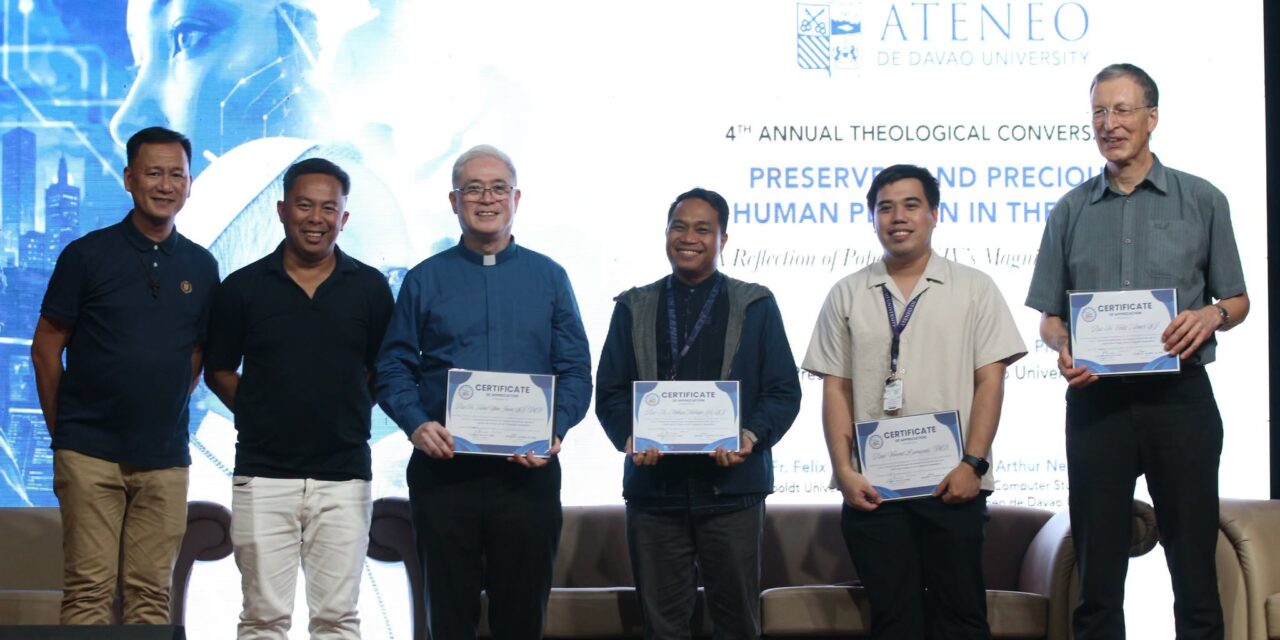
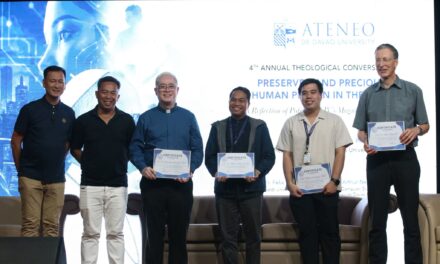
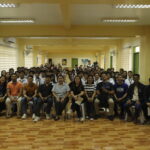
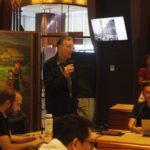
The Ateneo de Davao Theology Department, in partnership with the Office of the President and the Ateneo Internationalization for Mindanao Office, held the 4th Theological Conversation on 9 September 2026 at the Finster Auditorium, bringing together students, faculty, and international scholars to examine the relationship between emerging technologies and human personhood.
The joint Pakighinabi and Theological Hour served as a centerpiece of this year’s Theology Days, anchored on the question of what it means to remain human in an age of Artificial Intelligence (AI).
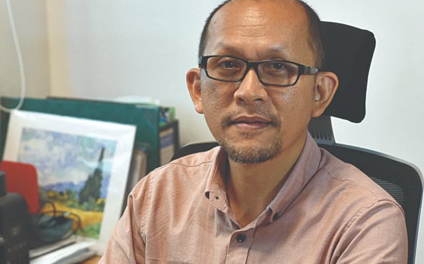
Theology Department Chairperson Dr. Roawie Quimba delivered opening remarks and introduced lecturer and University President, Rev. Fr. Karel S. San Juan, SJ, framing the discussion around AI in the light of faith, Pope Leo XIV’s call to “disarm” it, and how Magnifica Humanitas calls Catholics and all people of goodwill toward a civilization of love.
Understanding the Human Person in the Age of AI
In his lecture, “Preserved and Precious: The Human Person in the Age of AI,” Fr. San Juan drew on Pope Leo XIV’s encyclical letter Magnifica Humanitas to explore the dual nature of technological progress. While acknowledging that artificial intelligence offers powerful tools for efficiency and innovation, he stressed that it must never substitute human worth.
Fr. San Juan presented Magnifica Humanitas as a document that revisits what makes a person human, positioning the human person as the central reference point for evaluating progress. He said the world’s growing fascination with and dependence on AI calls for a return to that basic understanding of personhood.
According to Fr. San Juan, this human imperative is what Pope Leo XIV proposes for discerning and evaluating AI, as traced through Catholic Social Teaching and other foundational Church documents.
The first concerns the human person as both means and end of every endeavor, illustrated through a five-part sequence: one’s view of the human person and values shapes the analysis of reality, drives the process of change, and builds toward an achievable and ultimately an ideal reality, one grounded in a shared vision of world, society, and institutions. “Our values or vision of the human person will inform and influence the way we analyze our society,” he said.
The second, on authentic Christian humanism, holds that the human person exists in relationship with God, others, the self, society, and the material world, called to responsibility and respect while acknowledging human finitude, even as the person remains capable of self-transcendence and interior growth. Weighing this against artificial humanism, Fr. San Juan raised questions about how AI affects each of these relationships.
The third, invoking philosopher-theologian Bernard Lonergan’s transcendental imperatives, holds that AI is not a substitute for human living and flourishing. Human identity, he reminded the audience, is ultimately transcendent, grounded in embodied experience, understanding, judgment, and responsibility, capacities he said no algorithm can replicate.
The fourth drew on Maslow’s Hierarchy of Needs, from physical and security needs at the base through social belonging and ego, up to self-actualization. Fr. San Juan argued that self-transcendence goes a step beyond self-actualization and that AI does not respond to this hierarchy of human needs directed toward self-transcendence.
Panel Bridges Theology and Computer Science
Rev. Fr. Felix Körner, SJ, PhD, of Humboldt University of Berlin, framed the conversation as a vocation: “For being truly human, to work for a more humane world, a more fraternal world,” he said, reflecting on Magnifica Humanitas’s image of the “wise architect” guiding that vision.
Rev. Fr. Arthur Nebrao, SJ, MA, of the university’s Computer Studies Cluster, drew a sharper line between AI and human experience. “AI will welcome you, but there is no feeling,” he said. He said how AI carries no moral responsibility of its own, “These are algorithms and codes designed by human beings. We ourselves are accountable for all of our actions.”
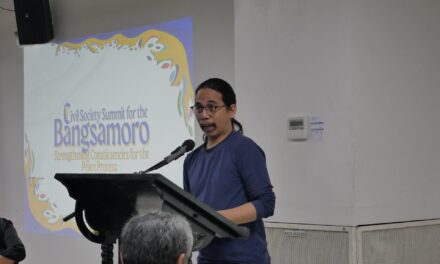
Raul Lumapas, PhD, also of the Computer Studies Cluster, argued that invention and innovation must return to humanity as their core. “We are challenged to change structures and systems that do not serve humanity anymore, and change is not bad,” he said. “Humans should not be enslaved by progress.”
Capping the Forum
Romulo Vinci Bueza, Director of the Ateneo Internationalization for Mindanao Office, delivered the closing remarks, officially capping the International Learning Session series of the Theological Forum. “This is also part of our responsibility as a Jesuit university in this age of AI,” he said. “Not simply to become more technologically capable, but to remain a place that forms people capable of discernment, judgment, compassion, and responsible action.”