Select Page


Community Engagement and Sustainable Development Office (CESDO)

Building Communities. Advancing Sustainability. Transforming Lives.

The Community Engagement and Sustainable Development Office (CESDO) serves as the central coordinating office for Ateneo de Davao University’s community engagement, extension, sustainable development, and institutional partnership initiatives. Guided by the University’s Jesuit, Filipino, and Mindanawon identity, CESDO promotes meaningful collaboration between the University and communities through programs that foster social justice, ecological stewardship, peacebuilding, and inclusive development.

As the University’s institutional hub for engagement, CESDO ensures that all community initiatives are participatory, innovative, sustainable, mission-driven, and aligned with the United Nations Sustainable Development Goals (SDGs) and the University’s strategic priorities.

Our Vision

A socially responsive, ecologically conscious, and globally engaged university community actively contributing to inclusive, sustainable, and transformative development.

Our Mission

The Community Engagement and Sustainable Development Office leads and coordinates Ateneo de Davao University’s community engagement, extension, sustainability, and development initiatives through participatory partnerships, academic integration, ecological stewardship, and community empowerment, grounded in Jesuit values and sustainable development principles.

Our Strategic Directions

CESDO advances the University’s mission by:

  • Strengthening institutional systems for community engagement
  • Mainstreaming sustainability and SDG integration across programs
  • Integrating engagement into instruction, research, and formation
  • Building reciprocal and transformative university-community partnerships
  • Promoting ecological justice, peacebuilding, and intercultural dialogue
  • Advancing social innovation and inclusive community development
  • Developing measurable, impact-oriented engagement initiatives

Institutional Mandate

CESDO provides strategic leadership in coordinating and harmonizing engagement initiatives throughout the University. The Office develops institutional frameworks, builds partnerships, monitors program outcomes, and ensures that community engagement contributes meaningfully to teaching, research, formation, and sustainable development.

Its work reflects the University’s commitment to forming graduates who are competent, compassionate, committed to justice, and responsive to the needs of Mindanao, the Philippines, and the global community.

Institutional Framework

CESDO operates through five interconnected institutional dimensions that guide all engagement initiatives across the University.

Institutional Dimension

Community Engagement
Sustainable Development
Academic Integration
Formation and Service-Learning
Social Innovation and Development

CESDO Function

Engagement Coordinates outreach, extension, volunteerism, and institutional partnerships.
Aligns programs with the Sustainable Development Goals (SDGs) and ecological sustainability frameworks.
Connects community engagement with instruction, research, innovation, and formation.
Supports immersion, reflection, Ignatian formation, and community-based learning experiences.
Develops participatory, innovative, and sustainable solutions that strengthen community resilience and empowerment.

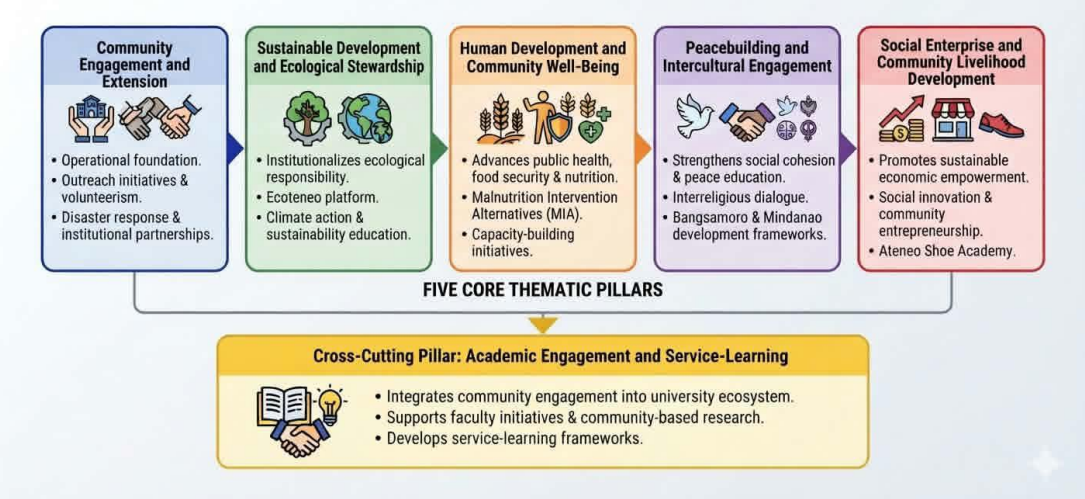
CESDO Core Thematic Pillars

CESDO’s programs are organized around five thematic pillars that reflect the University’s mission priorities and institutional commitments.
1. Community Engagement and Extension

This pillar serves as the operational foundation of CESDO by coordinating community outreach, extension services, volunteerism, disaster response, and institutional partnerships. It strengthens long-term relationships with communities while encouraging active citizenship among students, faculty, staff, and alumni.

2. Sustainable Development and Ecological Stewardship

Guided by Laudato Si’ and the Sustainable Development Goals, CESDO promotes ecological responsibility through climate action, environmental education, sustainable campus initiatives, and the University’s Ecoteneo platform. This pillar advances environmental sustainability both within and beyond the University.

3. Human Development and Community Well-Being

CESDO supports initiatives that improve health, nutrition, education, and overall quality of life among partner communities. Programs include the Malnutrition Intervention Alternatives (MIA), community capacity-building, public health initiatives, and projects that strengthen human development outcomes.

4. Peacebuilding and Intercultural Engagement

Rooted in Ateneo de Davao’s commitment to Mindanao, this pillar promotes peace education, social cohesion, intercultural dialogue, and collaborative engagement with diverse sectors. It strengthens partnerships that contribute to peacebuilding, particularly in the Bangsamoro and other culturally diverse communities.

5. Social Enterprise and Community Livelihood Development

CESDO empowers communities through sustainable livelihood initiatives, entrepreneurship, skills development, and social innovation. Programs such as the Ateneo Shoe Academy demonstrate the University’s commitment to creating opportunities that foster economic resilience and community empowerment.

Cross-Cutting Pillar: Academic Engagement and Service-Learning

Academic engagement connects all CESDO initiatives by integrating community experiences into the University’s core functions of teaching, research, and formation.

Through service-learning, community-based research, faculty engagement, and student immersion programs, CESDO enables academic knowledge to generate meaningful social impact while enriching learning through real-world experiences.

This cross-cutting pillar ensures that community engagement becomes an integral part of the Ateneo educational experience.

Hub-and-Network Model

CESDO operates through an integrated Hub-and-Network Governance Model, allowing the University to maintain strategic coordination while empowering individual academic units to respond to their communities’ unique contexts.

Central CESDO Office (Hub)

The Central CESDO Office provides strategic leadership and institutional coordination by:

  • Developing university-wide engagement policies and frameworks
  • Coordinating institutional partnerships
  • Leading sustainability and SDG integration
  • Monitoring and evaluating program impact
  • Harmonizing community engagement initiatives across all units
  • Consolidating institutional reports and documentation
  • Supporting innovation and continuous improvement in engagement systems

Basic Education CESDO Coordinators (Network Nodes)

Each Basic Education unit designates a CESDO Coordinator who serves as the local focal person for community engagement.

Their responsibilities include:

  • Coordinating unit-based community engagement initiatives
  • Aligning projects with University-wide CESDO frameworks
  • Facilitating service-learning and academic integration
  • Supporting SDG monitoring and documentation
  • Coordinating outreach, immersion, and community logistics
  • Assisting in University-wide advocacy campaigns and engagement programs
This distributed model strengthens collaboration while ensuring institutional coherence across Ateneo de Davao University’s educational continuum.

Advancing the Sustainable Development Goals

CESDO advances the University’s commitment to the United Nations Sustainable Development Goals (SDGs) by embedding sustainability across teaching, research, operations, and community engagement. Through strategic partnerships and evidence-based programs, CESDO contributes to poverty reduction, quality education, health and well-being, gender equality, climate action, peacebuilding, and inclusive economic development.

Every CESDO initiative is designed to create measurable social impact while strengthening the University’s role as a catalyst for sustainable and transformative development.

Our Commitment

At Ateneo de Davao University, community engagement is more than an institutional function—it is an expression of our mission.

CESDO invites students, faculty, staff, alumni, partner institutions, government agencies, civil society organizations, and local communities to collaborate in building a more just, peaceful, inclusive, and sustainable future.

Together, we form persons for others, communities for justice, and partnerships for sustainable development.