


Category: News and Stories
ADDU Honors Bobet Baterbonia’s Legacy, Celebrates Its Student-Athletes
Ateneo de Davao University (ADDU) permanently retired Jersey No. 2 and dedicated its covered courts in honor of Rene “Bobet” Baterbonia on November 23, 2026, in a ceremony at the Rene “Bobet” Baterbonia Covered Courts (RBBCC).
Held under the theme “Honoring the Legacy. Celebrating the Athletes. Building the Future,” the Athletics Recognition, Jersey Retirement, and Facility Dedication Ceremony brought together student-athletes, coaches, and members of the University community.
A legacy remembered, athletes celebrated
Mr. Brian Ric R. Constantino, ADDU SHS Sports Coordinator, opened the program on behalf of the University Sports Council. He said the occasion was about more than remembering a name. “Because the legacy we honor today is not meant to remain in the past,” he said.
Constantino explained that the three parts of the theme reflect the heart of the gathering: honoring Baterbonia’s service, celebrating the athletes and those who support them, and looking ahead. He noted that every victory is built on hours of training, sacrifice, and teamwork, and he thanked coaches, sports heads, teachers, and families alongside the athletes.
Athletes and coaches from the Grade School, Junior High School, Senior High School, and College were then recognized for their discipline, perseverance, and commitment to representing the University. Ms. Veya Yaoto, former College Athletics Council President and current Taekwondo Coach, led the University Sports Oath.
Fr. Karel S. San Juan, SJ, University President, told the athletes that Baterbonia lived out the values Ateneo hopes to see in them. “That is why all these values are portrayed, are epitomized, na isabuhay ng ating minamahal na Bobet Baterbonia,” he said.
Fr. San Juan said he was glad that the Senior High School students were present to witness what he called “a once-in-a-lifetime event,” as it shows how much Ateneo values athletics. He urged athletes to develop their gifts with discipline and teamwork and to compete with humility and gratitude for the greater glory of God and country.
Jersey retirement and facility dedication
A tribute video by the Ateneo Filmmakers Society followed. Fr. San Juan, together with representatives of the Baterbonia Family and the University Sports Council, then led the retirement of Jersey No. 2 and the dedication of the RBBCC.
The framed jersey and the facility marker were unveiled at the same time, and Fr. Eric Anthony Escandor, SJ, blessed the facility.
Gratitude and a commitment to the future
Ms. Rovelyn Baterbonia, mother of Rene “Bobet” Baterbonia, delivered a message of gratitude on behalf of the family. She thanked Davao City officials who facilitated the family’s travel to Davao, Fr. San Juan and the University for their support, and the Ateneo de Davao staff for the warmth shown to her son. She also acknowledged the coaches and supporters who have accompanied the family through the years.
Dr. Joan Grace A. Palconit, ADDU SHS Principal, delivered the closing remarks. “We have made a commitment to keep his legacy alive,” she said.
Dr. Palconit said the day was more than a symbolic retirement of a jersey number and dedication of a facility. She reminded the student-athletes that true greatness is measured not only by wins and championships, but by the character they build, the people they inspire, and the difference they make in others’ lives.
26 Schools Convene for Davao Model United Nations II at ADDU
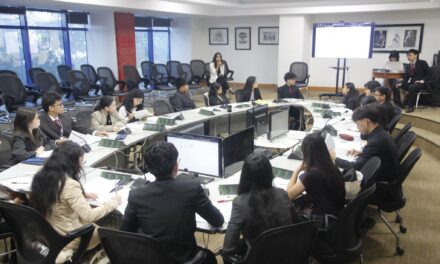
On 6–7 November 2026, Ateneo de Davao University (ADDU), through BAHAGHARI-ADDU and the Kapisanan ng Pag-aaral Pangkaunlaran at Sosyolohiya (KAPPS), in collaboration with the Davao Model United Nations (DavaoMUN), convened the Davao Model United Nations II (DavMUN II) at the Conference Rooms, 3rd Floor, CCFC Building.
The national interschool academic conference gathered student delegates from 26 schools and institutions across the Philippines to engage in diplomatic discussions, negotiations, and resolution-making on pressing local, national, and international issues.
A platform for diplomatic engagement
Modeled after the proceedings of the United Nations, DavMUN II provided student delegates with a platform to participate in formal deliberations and committee-based discussions.
Through negotiations and collaborative resolution-writing, participants examined contemporary global and regional issues while developing their critical thinking, research, problem-solving, public speaking, leadership, and diplomatic skills.
Following the success of its first iteration, which established a growing Model United Nations community in the region, the second conference sought to further strengthen Davao’s position as a leading center for Model UN initiatives in Mindanao. It also placed particular emphasis on issues affecting the region, including conflict-affected communities, Indigenous Peoples, and interfaith sectors.
Through its discussions and collaborative activities, the conference promoted inclusivity, mutual understanding, international awareness, social justice, peacebuilding, and responsible leadership.
Preparing delegates for the conference
Prior to the conference, participating delegates took part in preparatory activities through Model United Nations 101 on 12 and 19 September 2026. Held at the Training Room, 8th Floor, CCFC Building, the sessions covered research training, rules of procedure, mock simulations, and resolution paper writing.
These activities formed part of the conference’s preparation, covering essential areas of Model United Nations proceedings and resolution development ahead of the delegates’ participation in DavMUN II.
Advancing peace and responsible leadership
Beyond providing a platform for academic discussions, DavMUN II aimed to develop informed, socially aware, and globally competent young leaders who can contribute meaningfully to peace and sustainable development.
By engaging students in discussions on issues that extend from local communities to the international stage, the conference highlighted the importance of diplomatic engagement, mutual understanding, and responsible leadership.
The initiative reflects the University’s mission to form leaders for and with Mindanao and beyond, reinforcing its commitment to nurturing young leaders who work toward the common good.
ADDU Robotics Trains Davao del Norte Teachers, Students in AI and Robotics
Ateneo de Davao University (ADDU) Robotics Engineering Department, in partnership with the Marsman Drysdale Foundation, Inc. (MDFI) through Project PRIME (Partnership in Robotics and Intelligent Machines for Education), held the two-day Simplified Training-of-Trainers on AI, Automation, and Robotics Technology for Senior High School (START) on 14-15 November 2026 at Conference Room E, 3rd Floor, CCFC Building.
START brought together teachers and students from ten schools under the Schools Division of Davao del Norte and the Schools Division of Panabo City. It strengthened their foundational knowledge and practical skills in artificial intelligence (AI), automation, and robotics, and were equipped to share them in their schools.
Extending Project PRIME to Davao del Norte
Project PRIME first worked with Science, Technology, and Engineering (STE) schools in Davao de Oro in 2025. With START, the partnership now reaches DepEd schools in Davao del Norte, many of which sit far from the cities where robotics labs and trained instructors are easier to find.
Dr. Renyl B. Barroca, ME, Dean of the School of Engineering and Architecture, delivered the opening remarks. Engr. Ottoman B. Montani Jr., MEng, Chairperson of the Robotics Engineering Department, then explained the goals of the initiative.
Mr. Jeremy “Bong” S. Eliab, University Vice President for Administration, spoke on behalf of University President Fr. Karel San Juan, SJ. MDFI was represented by Ms. Yvonne Biyo, Executive Director, and Ms. Pearl Abba-Ulla, Program Manager. Dr. Maria Liza I. Berandoy and Dr. Rogar Garcia conveyed the message of DepEd Region XI Regional Director Maria Ines C. Asuncion, CESO III, while Ms. Ross Fievanni Inguillo did the same for DOST Region XI Regional Director Dr. Anthony C. Sales, PFT, CESO III.
Hands-on learning sessions
The first day alternated between talks and laboratory work. Participants discussed innovation and creative problem-solving, programmed a light show to try out simple automation, and assembled an automatic thermostat as their first step into robotics. The final session introduced AI by having them give their projects a voice, after which they were briefed on the Innovation Pitch-off.
On the second day, participants transformed their ideas into working projects, refined them, and presented them in the pitch-off. An awarding and closing ceremony capped the training.
What schools took home
Funded by MDFI, START gave each participating school a learning module prepared by the ADDU Robotics Engineering Department for teachers of Introduction to AI, Automation, and Robotics, along with an AIoT Starter Kit for classroom practice.
Participating schools are expected to share what their delegates learned through demonstrations, learning sessions, and other technology activities on campus, building a network of school-based trainers.
The University remains committed to working with schools, government offices, and industry partners with the aim of learners and teachers gaining hands-on exposure to the developing technology.
ADDU Achieves 100% Passing Rate in ChELE, Ang Places Top 5
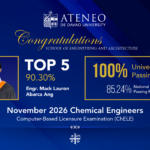
Ateneo de Davao University (ADDU) recorded a 100% passing rate in the November 2026 Chemical Engineers Computer-Based Licensure Examination (ChELE), producing 12 new Registered Chemical Engineers and a Top 5 placer.
A Top 5 finish and a first-place ranking
Engr. Mack Lauron Ang placed among the top five examinees nationwide, according to the official results released by the Professional Regulation Commission (PRC).
ADDU ranked first among institutions with 10 or more examinees, and its passing rate stands well above the national passing rate of 85.24%. The result highlights the strong performance of the University’s graduates in the licensure examination.
Joining Engr. Ang as new Registered Chemical Engineers are Engr. Christian Cacacho, Engr. Mariah Cruz, Engr. Yuen Xander Cua, Engr. Ellaine Mae Gumagay, Engr. Alionn Allen Horcera, Engr. Ella Jean Lanote, Engr. Althea Gwyneth Mata, Engr. Shana Georgyne Nicolas, Engr. Daniele Franz Palmones, Engr. Elena Gayle Remoroza, and Engr. Xyrelle Mae Solijon.
Gratitude to the Chemical Engineering community
The University extends its gratitude to the School of Engineering and Architecture (SEA) Dean, Dr. Renyl B. Barroca, ME; the Department of Chemical Engineering Chairperson, Engr. Ma. Leah Flor A. de Castro; and the Chemical Engineering faculty, staff, and students for their continued dedication to excellence.
ADDU warmly congratulates the new Registered Chemical Engineers on this achievement, which reflects the strength of the University’s Chemical Engineering program and the preparation of its graduates for the profession.
Robotics Engineering Students Place 2nd Runner-Up at AFP Ideathon 2026
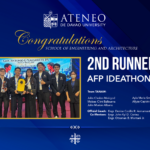
On 9 November 2026, Robotics Engineering students from the Ateneo de Davao University (ADDU) School of Engineering and Architecture (SEA) placed 2nd Runner-Up among 52 participating universities nationwide at the AFP Ideathon 2026 National Finals.
Competing as Team TANAW, students John Cholen Makigod, Moises Clint Balbuena, John Marion Albano, Ayla Marie Smith, and Allyza Capistrano presented “TANAW: Distributed AI-Based Aerial Perception and Multi-Target Tracking System for Counter-UAS Situational Awareness Operations.” The team was coached by Engr. Denise Cecille R. Armamento, with Engr. John Kyl D. Cortez and Engr. Ottoman B. Montani Jr. serving as co-mentors.
Organized by the Communications, Electronics, and Information Systems Service of the Armed Forces of the Philippines (CEISSAFP), the AFP Ideathon 2026 gives students and academic institutions a platform to showcase innovative technological solutions that support the modernization of the AFP and strengthen national defense.
The team’s camera-based system, “TANAW”
Drawn from the Bisaya and Filipino words “tan-aw” and “tanaw,” the project uses the sense of sight to support more informed decisions. This project addresses the gap in aerial awareness by providing enough information to determine what aerial objects are and how they are moving.
TANAW addresses a gap in aerial awareness, since knowing that something is in the sky does not always reveal what it is or how it is moving. This “distributed, passive aerial perception system” is designed to work alongside existing radar and command systems. Using several cameras and artificial intelligence, the system detects objects in the sky, determines their location and identity, and tracks their movement, even when multiple objects are airborne at once.
According to the team’s project summary, hundreds of unidentified aerial tracks are monitored every year within the Philippine Air Defense Identification Zone, while small drones flying at low altitudes are even harder to detect and identify.
Innovation in service of the nation
Through the development of locally built technology in the fields of robotics, artificial intelligence, and optical systems, project TANAW shows what Filipino students can contribute to the country’s technological capability.
Its focus on clearer situational awareness also supports sound threat assessment and well-informed decisions, which are essential to protecting national security and strengthening public institutions.
The project likewise reflects the value of collaboration among universities, government agencies, and defense stakeholders in developing homegrown solutions.
This achievement is a testament to the team’s hard work, commitment, and dedication to advancing innovation through technology. It also reaffirms the University’s commitment to forming innovators who serve the nation and the common good.