





Robotics Engineering Students Place 2nd Runner-Up at AFP Ideathon 2026
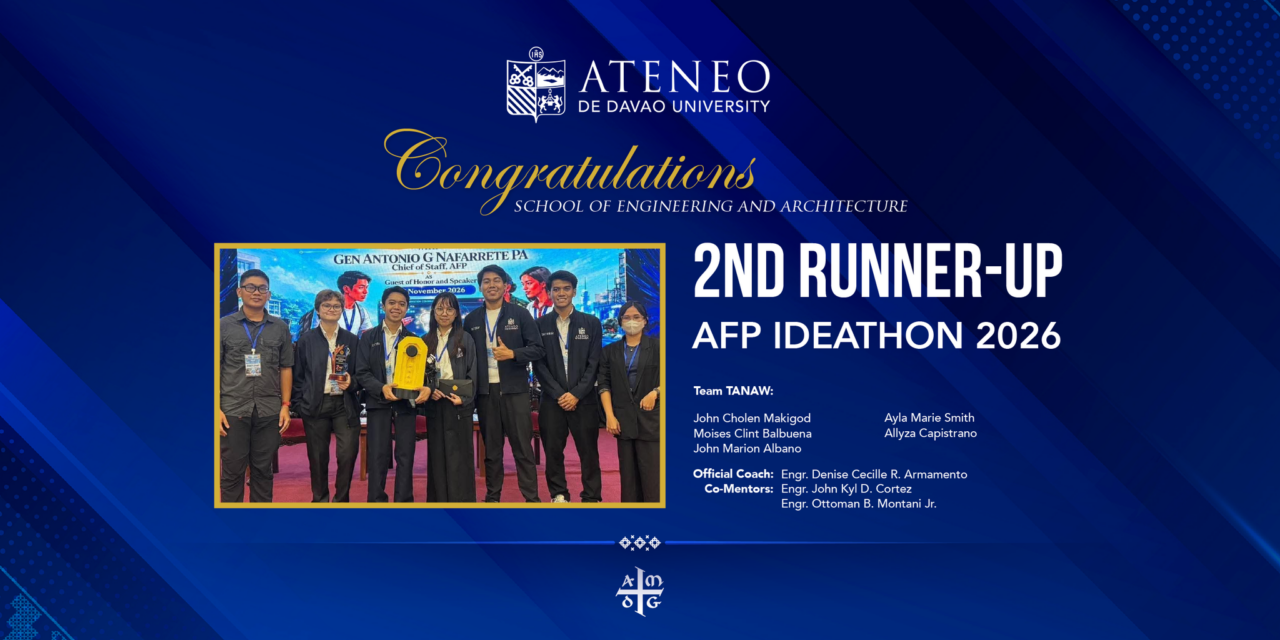
On 9 November 2026, Robotics Engineering students from the Ateneo de Davao University (ADDU) School of Engineering and Architecture (SEA) placed 2nd Runner-Up among 52 participating universities nationwide at the AFP Ideathon 2026 National Finals.
Competing as Team TANAW, students John Cholen Makigod, Moises Clint Balbuena, John Marion Albano, Ayla Marie Smith, and Allyza Capistrano presented “TANAW: Distributed AI-Based Aerial Perception and Multi-Target Tracking System for Counter-UAS Situational Awareness Operations.” The team was coached by Engr. Denise Cecille R. Armamento, with Engr. John Kyl D. Cortez and Engr. Ottoman B. Montani Jr. serving as co-mentors.
Organized by the Communications, Electronics, and Information Systems Service of the Armed Forces of the Philippines (CEISSAFP), the AFP Ideathon 2026 gives students and academic institutions a platform to showcase innovative technological solutions that support the modernization of the AFP and strengthen national defense.
The team’s camera-based system, “TANAW”
Drawn from the Bisaya and Filipino words “tan-aw” and “tanaw,” the project uses the sense of sight to support more informed decisions. This project addresses the gap in aerial awareness by providing enough information to determine what aerial objects are and how they are moving.
TANAW addresses a gap in aerial awareness, since knowing that something is in the sky does not always reveal what it is or how it is moving. This “distributed, passive aerial perception system” is designed to work alongside existing radar and command systems. Using several cameras and artificial intelligence, the system detects objects in the sky, determines their location and identity, and tracks their movement, even when multiple objects are airborne at once.
According to the team’s project summary, hundreds of unidentified aerial tracks are monitored every year within the Philippine Air Defense Identification Zone, while small drones flying at low altitudes are even harder to detect and identify.
Innovation in service of the nation
Through the development of locally built technology in the fields of robotics, artificial intelligence, and optical systems, project TANAW shows what Filipino students can contribute to the country’s technological capability.
Its focus on clearer situational awareness also supports sound threat assessment and well-informed decisions, which are essential to protecting national security and strengthening public institutions.
The project likewise reflects the value of collaboration among universities, government agencies, and defense stakeholders in developing homegrown solutions.
This achievement is a testament to the team’s hard work, commitment, and dedication to advancing innovation through technology. It also reaffirms the University’s commitment to forming innovators who serve the nation and the common good.